Make the Niki's Butterfly knot | Tutorial
Make 3 classic paracord bracelets | Tutorial DIY kit
Make your own survival or fashionable bracelet with the paracord knots 2 Color Fishtail, Shark Jaw Bone and Zawbar. A different closure is used for each of these bracelets in the tutorials.
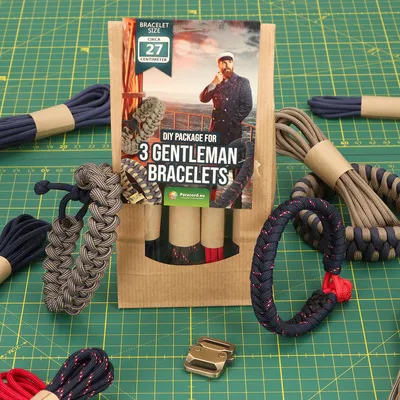
This blog article belongs to the DIY kits for paracord 550 bracelets. Of course, you can also make these bracelets by arranging materials yourself and following these tutorials.
When making the bracelets, it's handy to have these tools to hand:
- Scissors
- Blowtorch or lighter
- Tape measure
A jig is also very handy when making bracelets, as you will need to secure your work. Don't have a jig? Then you can also come up with a creative way to tighten the knotwork yourself.
Bracelet with the Fishtail knot
The Fishtail knot is a slim and simple knot of about 1.5 cm wide and 0.7 cm thick.

For the Fishtail bracelet, use the two ropes of 1.5 metres and the one-coloured rope of 1 metre. On the kit you can see which colours belong together.
You use the 1 metre rope as the core around which you will knot the other ropes. The knot closure is also made with this core.
You can find the explanation of the Fishtail bracelet in the video by CbyS below.
Bracelet with the Shark Jaw Bone
The Shark Jaw Bone knot, also called 'Piranha', is about 1.5 cm wide and 1 cm thick.

For the Shark Jaw Bone bracelet, use the 3-metre rope and the matching 1-metre rope. On the kit you can see which two colours these are.
As with the Fishtail knot, here you use the one-metre rope as the core for the bracelet. You will knot around this with the other rope. You also make the sliding lock with this one-metre rope.
You can find the explanation for the Shark Jaw Bone bracelet in the video by CbyS below.
Bracelet with the Zawbar knot
The two-coloured Zawbar paracord knot is about 1 cm thick and, with its width of 2.5 cm, the widest of these three bracelets.

For the bracelet with the Zawbar knot, you use the two ropes of 2.5 metres. For this bracelet you'll use the Safe Lock Buckle that you'll also find in the kit.
You need to determine the size of the bracelet beforehand. Measure your wrist and add 4 cm for the length of the bracelet. Do you have a wrist of 20 cm? The set-up should then be 24 cm long.
The first action in this tutorial is to join the two paracord colours using the Manny method. This involves using a paracord needle. Don't have this needle? Then just melt the ends of the two strands together.
Watch the tutorial for the Zawbar knot in the video below.
Frequently asked questions
How do you make a bracelet with rope?
You make a rope bracelet by first measuring your wrist and adding a few extra centimetres for knots and closure. Secure the rope, use a knotting technique such as fishtail, shark jaw bone or zawbar, and knot around a core or buckle. Finish by tightening the knots and carefully melting the ends so they do not loosen.
How do you make a paracord bracelet?
A paracord bracelet is made using paracord 550, a closure or sliding knot and a fixed knot pattern. Usually one or two long cords are knotted around a core or buckle. By repeating the pattern consistently, you create a strong bracelet that is both stylish and practical. Finish it neatly using scissors, a tape measure and a lighter.
What is a good knot for a bracelet?
Good knots for bracelets include the Fishtail knot for a slim and simple look, the Shark Jaw Bone knot for a tougher appearance and the Zawbar knot for a wide, eye-catching bracelet. These knots are strong, durable and very suitable for paracord bracelets with a survival or fashionable style.